Rice cheese (dairy-free and soy-free!)

veganricecheese.jpg

I was skeptical… vegan rice cheese? Surely it won’t melt, and will probably taste weird too. But the prospect of my dairy-free soy-free daughter getting to have “cheese” — on tortillas, in a sandwich, on pizza! — was too exciting to pass up, so I bought a pack of sliced cheddar flavor.

I thought I would try a quesadilla first. “Quesadilla?” she asked, her nose in a quizzical wrinkle. “Yes, do you want a quesadilla?” I responded. “You mean… with cheese??” she asked incredulously. “Yes, with a special kind of cheese that you can have.” “A special kind of cheese that I can have?” she parroted. Boy, I thought, this better be good after all this!

I put a little oil in a pan, threw in a corn tortilla and let it heat up and soften a bit, then turned it over and laid down a slice of cheddar flavor rice cheese. I doubled the tortilla over and waited… please melt, please melt. I peeked inside the tortilla — it melted! I gave it to her and watched her reaction. “Mmmmmm! I love this quesadilla! I love this cheese!” she emoted as she ate it all… and asked for another. It not only passed the test, but exceeded my expectations. And the best part is that she can have CHEESE.

So where does one find this cheese? It is made by Galaxy Nutritional Foods and can be found in various locations, including Whole Foods (you can look up your area here). Be careful though — there are 2 different rice cheeses and one has casein milk protein in it. I don’t understand why they would put casein in a rice cheese — isn’t anyone buying rice cheese doing so because they don’t eat dairy? Anyway, make sure you buy the one that says “Vegan” and “Casein and Lactose Free” on it.

Update 7/20/08: My friend said her daughter didn’t like it. Quesadillas are definitely the best use of the cheese and my daughter still likes them.

You could be sensitive to more than just gluten

You have eliminated gluten from your diet and you feel a lot better. You are very careful about what you eat, but you still have symptoms that you blame on gluten somehow sneaking into your food via cross-contamination or because you were not being careful enough. You may be frustrated or confused as to why you are still have reactions when you can’t figure out where the gluten could be.

Perhaps you are getting traces of gluten, but the reality may be that you are reacting to another food. That’s right — you may be sensitive to more than just gluten! It’s not a pretty thought to have to cut another food (or foods) out of your life, but it may make you feel a lot better.

My discovery

After I was gluten-free and felt dramatically better, my body and especially my digestive system, felt clean… I don’t know how else to describe it, but it just felt like there was no turmoil going on inside, like a glass of water without any bubbles. If I did get a trace of gluten, I knew it, and I would track down the source. But then there were times when I had cooked at home and knew that there was no way I could have gotten glutenized (I am sure they will be adding this word to Webster soon!), but still didn’t feel perfect.

After keeping a mental food diary — really paying attention to when I didn’t feel well and what I had eaten prior — I realized that I was blaming gluten for those days when my tummy was feeling, well, bubbly. But it wasn’t gluten at all. It was… drumroll, please… soy! Yes, folks, I do not eat soy anymore. I do eat a little wheat-free soy sauce sometimes and soy lecithin, but other than that, no soy. My daughter is soy-intolerant also, so there you have it — genes at work. Lucky girl… at least she got some of my good genes too: charm, good looks, etc. — ha ha!

I’m not the only one with multiple food sensitivities. In fact, on the celiac.com forum, there is a whole category called Other Food Intolerance and Leaky Gut Issues with people talking about how they have realized that they are intolerant to more than just gluten. This is no coincidence…

Leaky Gut Syndrome

A reason that people can develop more food sensitivities could be leaky gut syndrome, also known as increased intestinal permeability. A very simple explanation of what happens with leaky gut syndrome is this:

  1. Large spaces develop between the cells of the intestinal wall (due to many possible causes — see below).
  2. Bacteria, toxins, and incompletely digested proteins and fats leak in. Normally these larger molecules would be kept within the intestines, but because of these holes in the intestinal lining, they leak through the intestinal wall into the bloodstream, where they normally shouldn’t go.
  3. The immune system releases antibodies to fight what it sees as foreign invaders in the blood.
  4. These antibodies also attack the body’s own cells, causing damage, allergic reactions, pain and inflammation throughout the body.

What causes leaky gut?

Some of the possible causes of leaky gut syndrome are:

  • Damage caused by taking non-steroidal anti-inflammatory drugs (NSAIDs), like ibuprofen
  • Gastrointestinal disease, like celiac disease
  • Eating allergenic foods
  • Consuming alcohol
  • Consuming caffeine
  • Taking antibiotics
  • Eating too much sugar
  • Ingesting toxic chemicals
  • Intestinal infection
  • Parasites
  • Stress

Food sensitivity can cause leaky gut, which can then cause other food sensitivities — it is a vicious cycle.

So, where do you go from here?

If you are gluten-free and you don’t know why you are still having reactions to the food you are eating, I would recommend that you keep a food diary — write down the time that you eat, what you eat, what symptoms you feel at what time of day. If you wake up in the morning and feel fine, and then have breakfast and feel rotten the rest of the day, examine everything you are eating in the morning, from coffee to juice to the milk you pour on your cereal. Once you think you know the problem food, cut it out and see how you feel. You can add it back in later and see if you react (please consult your doctor if you think you are at risk for a serious reaction to a food). In my case, after I cut soy out my diet, my lingering symptoms went away, and I have not wanted to try it again!

And what about that leaky gut? There are a lot of websites out there with advice about how to improve the permeability of your intestines. I am going to start doing some of these things for myself and my family in hopes of preventing more food sensitivities. Here are a few of the sites I found useful:

Liverdoctor.com
The Environmental Illness Resource
Dr. Weil
Leaky Gut Syndrome

Do you have more than one food sensitivity? Let me know in the comments… I’m curious!

Get your allergy-free cupcakes ready

glutenfreecupcake.jpgNow that my daughter is in preschool, we are on the birthday party circuit. Telling her she can’t have a piece of cake or cupcake because of her food allergies would be upsetting (for both me and her), which is why I make sure that I always have cupcakes on hand. Here’s how you can do the same and be a superstar mom or dad!

Do this now:

  1. Make a batch of chocolate cupcakes, and freeze what you don’t need to use that time, or even double the recipe to make sure you have extras. The easiest thing to do is make a mix, like Pamela’s chocolate cake mix or CherryBrook Kitchen (both good for egg-free). I also like Gluten-Free Pantry and Namaste. Any cake mix can become cupcakes, just cook for less time!
  2. vanillacupcakes.jpgMake a batch of vanilla cupcakes too. Vanilla cake is harder to make egg-free, but Pamela has a vanilla cake mix that I have made with egg replacer and they turned out okay (see picture at right) even though the directions say it will not work! Or, if you’d like, make a cupcake from scratch using a gluten-free recipe. And, by the way, muffins magically turn into cupcakes when topped with frosting and sprinkles, so that’s another option!
  3. Make chocolate frosting and vanilla frosting and keep them in an airtight container in the refrigerator. Tip: Start by making vanilla frosting, take out half and then add the cocoa to make chocolate — that way, you really are only making one batch of frosting. You can use frosting mixes, like Pamela’s (I substitute softened palm shortening for the butter to make it dairy and soy-free), or you can use good old C&H powdered sugar and follow their easy recipes, some of which are below.

Do this later:

  1. Before the day of the party, talk to the host of the birthday party to find out what food they are serving (in case you also need to bring your own snacks or lunch) and what kind of cake or cupcakes they are having. It is usually always some combination of white or chocolate cake and white or chocolate frosting. Try to match what they are having.
  2. The night before or the morning of the party, take some cupcakes out to thaw. I bring 2 for my daughter just in case, but she usually only has one. Also, I like to have one on hand in case someone else needs an allergen-free cupcake (hasn’t happened yet, but when it does, I will make someone’s day!) If it is really last-minute, you can thaw the cupcake in the microwave.
  3. Take out your frosting to thaw also. Or, you can microwave it just as you would to soften butter (don’t melt it).
  4. sprinkelz.jpgFrost and decorate the cupcakes. If you want to get fancy, you can use decorating tools. It is actually really easy and you get to feel like a pastry chef for a minute! For sprinkles, I like India Tree brand or Let’s Do Organic Sprinkelz, which are gluten-free (most sprinkles contain wheat). As long as you’ve got yummy frosting and sprinkles, the cupcake part doesn’t even really matter that much!

Now SMILE and pat yourself on the back because your child has not been deprived of that age-old birthday treat - the CUPCAKE!

A few allergy-free frosting recipes adapted from C&H website:

Basic Decorating Icing (good for piping)
Ingredients:

  • 4 cups powdered sugar (a one-pound box of C&H)
  • 1/2 cup butter or shortening (palm if you want to make it soy-free)
  • 1/4 cup water or milk (rice milk works well)
  • 1 tsp. vanilla or other flavoring
  • food color (optional)
  • add 1/4 cup unsweetened cocoa powder if you want to make chocolate

Instructions: Beat all ingredients until smooth. Keep icing covered to prevent drying. Store in refrigerator. Thicken with powdered sugar or thin with a few drops of water or milk, if needed. Makes 2 1/2 cups.

Vanilla Glaze — a traditional glaze for coffee cakes and sweet rolls, but good on cupcakes too!
Ingredients:

  • 1 cup powdered sugar
  • 1 1/2 tbsp. milk (you can use non-dairy milk — rice milk works great)
  • 1/2 tsp. vanilla

Instructions: Beat all ingredients until smooth. Makes 1/2 cup.

Chocolate Glaze — A smooth, rich glaze for cookies, cakes, cupcakes and more!
Ingredients:

  • 1/4 cup chocolate pieces, semisweet
  • 1 tbsp. butter or margarine (or shortening)
  • 1/2 cup powdered sugar
  • 1 1/2 tbsp. milk (or rice milk)

Instructions: In small saucepan, melt chocolate with butter (or shortening). Remove from heat and beat in powdered sugar adding milk gradually until mixture is a pourable consistency. Makes enough glaze for a layer cake.

Product Review: Coconut Bliss dairy-free ice cream

coconutblisschocolate.jpgRating: bluestar3.jpgbluestar3.jpgbluestar3.jpgbluestar3.jpgbluestar3.jpg

Product description:

Coconut Bliss:

  • Non-dairy frozen dessert (ice cream) made from organic coconut milk and agave syrup
  • Gluten-free
  • Vegan (which means no milk and no eggs)
  • Soy-free
  • Low glycemic index

Review:

Move over Ben & Jerry and make way for Luna & Larry! I have just discovered Coconut Bliss ice cream and I am in love! I have tried many dairy-free ice creams, including soy-based ones and rice-based ones (and some that are made with both rice and soy like Rice Divine). This one is made with coconut milk as its base, and adds no soy or gluten. The result is a rich and creamy ice cream that rivals or even tops dairy ice creams in taste and texture. This is definitely a dessert I would serve to all my guests, not just to my dairy-free kids (in fact, I haven’t decided if I’m even going to share it with them at all!)

I love that the ingredients are pure and agave syrup is used for the sweetener instead of sugar. While the fat content isn’t lower that other ice creams, there is no cholesterol. And if you’d like to learn about the health benefits of coconut, Luna & Larry recommend the website Coconut Research Center.

I can’t wait to get through dinner tonight, so I can delve into dessert!

What I like:

  • It is so creamy, just like “real” ice cream
  • The flavor makes you say “yummmmm”
  • It comes in many flavors: Naked Coconut, Dark Chocolate, Vanilla Island, Mint Galactica, Cappuccino, Cherry Amaretto, Pina Colada, Cinnamon Chocolate Flake, Strawberry Lemon Love, Chocolate Hazelnut Fudge

What I don’t like:

  • That 2 flavors have nuts (my daughter is allergic so I need to think about the possibility of cross-contamination)
  • I haven’t tried all the flavors yet (and can’t wait!)… I’ll let you know if there are any I don’t like

Where to buy:

As of June 2008, Coconut Bliss is only sold in the western United States. I found it in Whole Foods.

Someday everyone can eat soy… yeah, right

soybeans.jpgAccording to a recent news article, research out of Illinois and Madrid shows that fermenting soybeans reduces the allergenicity of the beans by breaking down the proteins into small pieces so that they don’t provoke an allergic reaction. This research suggests that soy products in the future could be made to be hypoallergenic, allowing allergic individuals to eat them.

What is not clear from the article is if the fermentation process has to be done with specific bacteria (the bacteria that was used in the study) in order to break down the proteins, or any bacteria. There are already soy products that are fermented — soy sauce, miso, tempeh — but to my knowledge soy allergic or intolerant people cannot eat these things.

So, while this study seems promising, the reality is that food producers would have to change their manufacturing processes to include a fermentation step, and perhaps a very specific one. This of course means more time and more money on the part of the manufacturers… and therefore, we probably will not see this change come about anytime soon, if ever.

Sorry to be seeing half-empty, but I would rather (in the long meantime) see manufacturers take the soy out of their products. It is unbelievable to me how many products contain soy! My daughter has, and I believe I do also, an intolerance to soy, and while it is avoidable, it is just plain annoying how many foods contain soy for no reason (except that it’s cheap). I think it’s time that food manufacturers take responsibility for their ingredients and stop feeding people crap. Seriously. It’s disgusting. Am I right people?

Related reading: Soy Allergy Basics

Dairy-free, soy-free margarine?

Dairy-free, soy-free margarine does not exist to my knowledge. Most baking recipes call for butter or margarine, and Earth Balance Buttery Sticks or Shortening Sticks work great if you can tolerate soy. (Buttery Sticks contain soybean oil and soy protein, Shortening Sticks contain soybean oil.) But what is a dairy and soy-intolerant person to do?

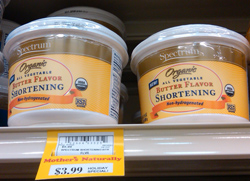
spectrumshortening.jpgI have been using Spectrum Naturals Organic Shortening which is non-hydrogenated palm oil. It has worked for me in baking recipes that call for butter or margarine. I follow the Joy of Cooking (my favorite cookbook for learning the basics) substitution recommendation for shortening in place of butter:

for 1 cup of butter (2 sticks) replace with 3/4 cup + 2 tablespoons of shortening

So far, my cookies (gluten-free, egg-free, dairy-free and soy-free) have turned out with a light and fluffy texture and taste really good! (You don’t really taste the shortening at all.) I was so happy to discover this product when I cut soy out of my daughter’s diet in addition to gluten, dairy and eggs! Yippee!

Look for Spectrum shortening at a natural foods or health foods store, or you can buy it on Amazon.

Rice yogurt!

riceyogurt.jpgToday I went shopping at Andy’s Market in Sebastopol, CA because they have an amazing selection of gluten free products, including gluten free oats and oat flour. As I was browsing the dairy aisle, I discovered a yogurt called Ricera, which is made from whole grain rice and rice protein, contains the usual active cultures found in other yogurt, but has no dairy or soy. It is processed on shared equipment that is used for soy and dairy products, but it is thoroughly cleaned in between to reduce risk of cross-contamination. It came in four flavors: vanilla, blueberry, peach, and strawberry. I bought the vanilla and blueberry flavors to try. Here’s the review.

Both flavors were good! The overall texture was creamy and yogurty, although the vanilla was just slightly gritty. The color of the vanilla wasn’t appealing because it was light brown (it’s made from brown rice), but the blueberry looked like any blueberry yogurt. I detected a hint of a bitter aftertaste in both, but it wasn’t too strong. Mostly, it had the sweet/sour taste of regular yogurt.

I know that my children would enjoy it like they do any yogurt, with some cereal poured on the top to stir in. For someone who hasn’t ever been able to have yogurt because of a dairy or soy allergy, rice yogurt may be a small dream come true.