 My grandmother just turned 98 years old. 98! She is amazing, still remembering intricate details about her life. She can still converse on any topic from the state of education to how many times Lance Armstrong has won the Tour de France. She’s also totally up on the whole gluten-free thing, and recently she told me a memory she had from when she was a little girl.
She was in the kitchen where her grandmother and her grandmother’s friends were gathered to bake and talk (my grandmother was raised by her Danish grandparents in South Dakota after her own parents died in the flu epidemic of 1918 when she was 6 years old — what that generation went through is incomprehensible). As they stood around chatting, my grandmother heard her grandmother say, “I like this new flour — it’s got more gluten in it.” Aha! Perhaps there is a history lesson here about why wheat is making people sick! (says the former history teacher)
People often ask me, “Why does it seem that suddenly everyone is intolerant to gluten?” After some research, I have concluded that the phenomenon of celiac disease and gluten intolerance has, in a way, come about rather suddenly. Why? Because gluten is far more prevalent in our society today than just 100 years ago (but a blip on the timeline of human existence). As the consumption of gluten has increased, the problems associated with gluten have too.
 Wheat today is different than it was 100 years ago. It’s got more gluten in it! Until the 1870s, almost all U.S. wheat production consisted of “soft wheat” varieties. A “hard spring wheat” variety (originally from Central Europe) with a higher protein content (aka gluten) was introduced in the U.S. in the mid-1800s. The flour made from the higher gluten wheat resulted in fluffier bread and flakier baked goods — this was amazing stuff!
The demand for the new flour grew, but it wasn’t so easy to get at first. Although some early types of wheat may have been grown as far back as 9000 B.C., people didn’t each much of it because it was difficult to eat in its raw form, and even when they figured out how to crack it open, to grind it, to sift it and to cook with it, these processes were laborious because they had only primitive tools. Whole grains also went rancid rather quickly because of the high oil content in the bran.
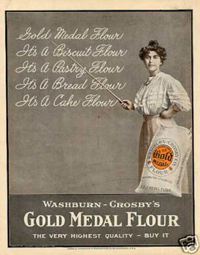 It was eventually discovered that milling the grains (stripping away the germ and the bran) made it so the grains could be kept for longer and also produced a soft, unadulterated white flour. By the early 1800s, many mills had equipment so that they could produce this refined flour. Demand for white flour grew as it became the desirable baking ingredient. Because it was more expensive than brown flour, it also became a status symbol.
It wasn’t until the late 19th century that wheat production and consumption grew dramatically. One reason, as mentioned before, was the use of the new, hardier strains of wheat. (Today, wheat can be grown every month of the year somewhere in the world.) Also at this time, great advancements were made in the technology used to grow, harvest, mill and transport wheat. Inventions such as the reaper, the steel plow, and high speed steel roller mills, helped produce huge quantities of finer, whiter flour. Railroads provided better transport of the flour, making it available to more people, and better ovens allowed them to bake with it even more. With all of these advances, the masses had access to the refined wheat flour that was once a luxury of the wealthy.
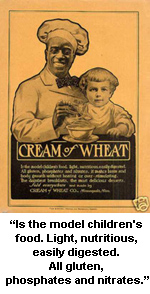 They also found new ways to eat wheat. Though eating a big bowl of cereal for breakfast seems the norm today, it was only in the late 1890’s that breakfast cereal was invented as a health food to help people with digestive problems! Kellogg and Post were among the first to come up with processed cereals in the form of flakes, shredded wheat and Grape Nuts. It was around this time that Quaker introduced oatmeal and Cream of Wheat was born. The popularity of cereal continued to rise throughout the decades — the cereal of today is not quite the health food it was once thought to be!
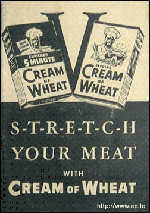 Though wheat consumption slowed a little bit from 1920 through the Great Depression and World War II, people were encouraged to find alternatives for meat and dairy due to war rationing. Thus, Kraft macaroni and cheese dinner, introduced in 1937, gained popularity during wartime and an entire pamphlet of recipes using Cream of Wheat instead of meat was published, with the slogan “Stretch Your Meat With Cream of Wheat.” The rise and fall in wheat consumption during World War II in five different countries correlated to the increase and decline in the number of schizophrenia patients admitted to hospitals in those countries, according to a 1966 study.
By the time the 1960s and 1970s rolled around, wheat consumption began to rise again. People became concerned with heart disease and cholesterol and whole wheat was viewed as a healthy alternative to combat these health problems. Wheat consumption in the U.S. saw another great increase with the huge rise in the fast food industry in the 70s and 80s. People on the go could now pick up sandwiches, hamburgers, chicken nuggets, pizza, and bagels just about anywhere.
Today, wheat is the single most cultivated crop worldwide. Most people in the United States eat wheat at almost every single meal, every single day, and for snacks and dessert too. Bakers are adding in “vital wheat gluten” or high gluten flour to make fluffier loaves of bread. Vegetarian and vegan meat substitutes are made from extracted gluten. Wheat is everywhere and then some! It’s no wonder we are not tolerating this food that has “suddenly” become our dominant food source.
“The body is not built wrongly, but is being used wrongly” proposed T.L. Cleave, author of a 1974 book called The Saccharine Disease, which addressed health conditions that he believed to be caused by sugar and white flour. Rather than viewing people who are unable to tolerate gluten as defective, we need to recognize that it is the change in our environment — the increase in wheat consumption — that has led to our ill health. My grandmother’s memory serves as a reminder of these changes that have occurred in just a short time.
Thank you, Grandma, for inspiring this post. Here’s to 99!








Elese says
Thank you for a very concise, comprehensive, well-written post. You have a lovely and helpful website! Thank you for all your hard work to bless and benefit others. 🙂
Telia says
My daughter is about to do her exit project on gluten sensitivity! She loves your article, can you send us a list of your sources, please! My computer stopped working lately, I intend to buy a new one! We are using my kindle! Thank you for your information, GOD BLESS you& yours!
deborah says
I would strongly encourage people to check out pinterest then type in einkorn flour, etc. The information is amazing and helpful for the learning curve in using einkorn.
I was hesitant to venture into pinterest but love it totally now.
Cheer!
reedbarnes says
As a former history teacher you should probably stay away from early Mediterranean Basin teaching… Despite what you may believe, we probably consume less wheat now than in antiquity. In large parts of Ancient Rome and Egypt, it accounted for by and large the majority of calories consumed. It was consumed as bread sure, but also as porridge and other methods. Porridge is easier because you don’t need to grind it into flour, just break open the grain and add milk or water, flavor if you got it, and eat.
And that was just Wheat. Barley in Greece and Rye in Northern Europe. All gluten… all the time. Which is one of the reasons why celiac disease, or at least the symptoms of it, was known in history. One difference likely would be very few other than the wealthy elite could have afforded “gluten-free” lifestyles.
Your problem is you look at history wrong… flat out. Meat wasn’t overly an option then. Preserving it was “possible” but less than desirable. Fresh fruit and veggies? Yea maybe directly after a harvest, but how about that whole in-between part? Grains are one of the few foodstuffs that are easily stored for long periods of time without decaying.
Maybe you should examine historical literature in reference to historical diets? Think about what you eat today, and imagine grain for breakfast, grain for snacks, grain for nearly every meal. There are reasons Rome alone had to import over 400,000 tons of the stuff a year under Augustus. (BTW that works out to be about 500 pounds a person)
Perhaps you should research your history before teaching it?
Sherry says
There were ancient methods of preserving foods such as fish, meats, vegetables and fruits. Drying of fruits meats and fish were employed (dehydration using the sun), the smoking of meats and fish, salting, pickling and fermenting. (Wines for example led to the concept of canned food – “Nicolas Appert (17 November 1749 – 1 June 1841) was the French inventor of airtight food preservation.”) (and even using honey, which contains hydrogen peroxide, to store foods in clay jars). And even the use of cold (winter and snow/ice). (see link below on Ancient Rome)
My mother grew up on a dairy farm and taught us children, how to preserve foods (peaches and other fruits from our trees). I used to live in NYC and visit the museums where one could learn of various ancient cultures (as well library since a child). And books on different cultures and their cooking methods.
….
https://dryfoodcraze.com/9-ancient-food-preservation-methods-we-do-today/
The sun and wind would have dried foods naturally. As early as 12,000 B.C., ancient Egypt, countries in the Middle East and other cultures in the Far East were already dehydrating nuts, fish, fruits, and meat under the sun
The Romans were fond of drying fruit in a dehydrator.
During the Middle Ages, they built “still houses” to dry fruits, vegetables, and herbs in areas that didn’t have strong sunlight for drying. They use fire to create the heat needed to dry foods. In some cases, they smoke them as well.
https://dehydratedfoodz.com/when-were-food-dehydrators-invented/
Native Americans would often use smoke from a fire to dry out a variety of foods, including meat, herbs, and vegetables. Some vegetables, like potatoes, could be dehydrated by leaving them out to freeze overnight, and then crushing them the next morning.
By drying food, nomadic peoples were able to preserve their food from one season to another. But those who lived in permanent settlements also used dehydration.
In Europe, residents began constructing buildings known as stillhouses that were designed to dehydrate food. In these buildings, they would hang food from strings, and use heat from a fire to dry it.
…………….
As well, hunting and fishing was common all throughout the year, (harder in winter) but both could be preserved for the lean times.
https://dryfoodcraze.com/9-ancient-food-preservation-methods-we-do-today/
…………….
Burial
Think about it, burying food in soil or sand sounds unappetizing. But in the past, burying food is part of the fermentation process.
The lack of light, the lack of oxygen, the cool temperature, the pH level of the soil, and the desiccants in the soil contribute to the effectiveness of this food preservation method.
The Chinese created century eggs by placing these in alkaline mud. This will ferment the eggs, breaking down some of the proteins and fats and turn the eggs into a flavorful delicacy.
In early U.S. history, cabbage was traditionally buried during autumn for preservation, a method on how they make sauerkraut or any pickled or fermented vegetable.
Meat can also be buried on hot coals or ashes. The heat coming from the coals kill microorganisms, while the ash can desiccate, and the soil can prevent air and further contamination. Fat will be taken from the meat and make it tallow. The tallow is heated and poured over the meat in a barrel. Once the fat hardens, the barrel is sealed and buried.
Butter, cheese, and meat-based products have been preserved as bog butter buried in peats for many years.
……………..
Here is another link to show one culture, ancient Rome and their methods of preservation (of course the upper class had more options). (and yes the grains were important but not the sole food)
………………….
Food in the Roman World – Ancient History Encyclopedia
http://www.ancient.eu/article/684
The ancient Mediterranean diet revolved around four staples, which, even today, continue to dominate restaurant menus and kitchen tables: cereals, vegetables, olive oil and wine. Seafood, cheese, eggs, meat and many types of fruit were also available to those who could afford it.
The Romans were also adept at processing and conserving their food using techniques from pickling to storage in honey. Flavouring food with sauces, herbs and exotic spices was another important element of Roman food preparation. Our knowledge of just what the Romans ate and how has been gathered from texts, wall-paintings and mosaics, and even the remains of the food itself from sites such as Pompeii. Cereals made up the bulk of most people’s diet with wheat and barley being the most common and used especially to make bread and porridge. Bread was generally coarse and dark in colour, the better quality loaves being less dark and finer in texture. Innovations in grinding mills and finer sieves helped improve the fineness of flour over time but it remained much coarser than modern standards. Besides wheat and barley, oats, rye, and millets were also available.
Meat could be an expensive commodity for most Romans and so was commonly prepared as small cuts or sausages. Poultry and wild game were important sources of meat, but pork, veal, mutton, and goat were also available. Game such as rabbit, hare, boar, and deer could also be farmed in large enclosed areas of forest. An astonishing variety of birds such as partridges, pheasants, geese, ducks, blackbirds, doves, magpies, plovers, woodcocks, and quails were also valued for their meat (caught wild or farmed), and just about any sizeable exotic bird, from flamingo to peacock, ostrich to parrot could find itself in the cooking pot of an aristocrat’s chef, eager to impress his master’s honoured dinner guests. Meat could also be conserved by salting, drying, smoking, curing, pickling, and preservation in honey. Fish, most of which are still found in the Mediterranean today, could be eaten fresh, dried, salted, smoked or pickled. As supply was irregular, the preservation of fish ensured a useful protein addition to the Roman diet. Fish and shellfish were also farmed in artificial salt and fresh-water ponds. Fish sauce (garum) made from matured whole small fish or the interior of larger fish was an extremely popular method of flavouring. Crayfish and crabs were also eaten and shellfish available included mussels, clams, scallops, and oysters.
Just who exactly ate what and when in Roman times continues to be a fertile area of scholarship, but the archaeological record provides ample evidence of the variety of foodstuffs available to at least some of the Roman populace. We can also see that the Romans were skilled at ensuring a continuous supply of those foodstuffs through diverse agricultural practices, artificial farming techniques, and food preservation methods. Indeed, their relative success is indicated by the fact that such a scale of food production would not be seen again in Europe until the 18th century CE.
……………..
Salt. Salt has been used as a preservative since the beginning of recorded history. It was used in China as early as 1200 B.C. The Jews were early users of salt to preserve meat products. This would seem natural be cause of their access to the supply of salt from the Dead Sea. Salt -fish was a common commodity in Ancient Greece. The Romans were schooled in the use of salt as a preservative by the Greeks. The Romans used it in preserving fish and pork products.
The Roman Food Supply System. The Romans became very adept at curing and preserving meat products. They established slaughter facilities and meat shops that were much superior to those found in any other part of the world. Julius Caesar was able to supply his legions with meat and other food products because of the efficient manner in which food was processed, stored, and distributed in Rome.
Honey . The Greeks and Romans used honey as a preservative. Honey was also used in combination with vinegar and other ingredients. Honey, because of its high sugar content, inhibited the growth of microorganisms, and imparted a desirable taste. Honey, combined with vinegar, salt, and other ingredients, resulted in a sweet pickling solution resembling our sweet pickling process used today.
Rick Schermerhorn says
Right now 54%.of Americans have some type of chronic disease
For the most scientific epically County in history
I believe that gluten GMOs and Roundup are partly responsible along with high fructose corn syrup, aluminum in vaccines
FDA says they’ll give the public the report of Pfizer’s vacvine 75 years from now
And soy has been poisoning us for decaded
Alison says
I agree with you, Rick, that all of those things are detrimental to our health!
Melba White says
I read that the quick rising yeast also adds to the problem. Slow rising methods allow for the gluten to break down before the dough is baked.
Scott says
The seeds can stay viable and not-rancid for hundreds of years, at least, typically, as I’ve understood from the information I’ve seen so far. It’s only if you smash or grind the grain up that it gets rancid within a year or months or weeks, depending on if and for how long the ground up grain is stored.
Alex Withers says
This article is very misleading! I agree 100% with Reed Barnes’ comment. Nowadays, everyone online, offline, and even in schools are misappropriating valuable information. Its sad but truly wise individuals will know the thruth through traditional values and–sense that isn’t so ‘common.’
Marilynn Montgomery says
Y’all, read “Wheat Belly” by William Davis,MD. It’s s well written commentary that corroborates the the info in this post. The book set me on an investigative journey that opened my eyes to a great many things about wheat, and gluten and their many deleterious effects. This article filled in the historic gap in the development of flour and cereals in the United States. I have insulin dependent type I diabetes of 56 year duration. I never knew that type I can be caused by gluten, wheat. I thought the etiology of my “disease” would remain a mystery forever. However, with this breakthrough, perhaps preventative measures such as a vaccine may now become s reality.
The professor who dissed this article should stick to straight historical facts, research and study. Apparently he knows nothing about health or medicine. Nor does he know anything about the difficulties and angst suffered by those of us with long term chronic diseases. yours, MGM
Jackie Caldwell says
Great article!
There is a way to offer criticism without being so rude.
Maybe that is something you didn’t learn in your history lessons.
Todd Brown says
Wheat wheat wheat What we eat today is an altered form of wheat then we ate through history so the wheat we eat today is a far cry from the wheat we ate in Roman times. This modern wheat has been modified from the original strain which our body tolerated better then the high gluten wheat of today. We live in a time and place that we need to feed the masses. Intern we need to develop a wheat that grows all the time and is resistant to disease and other factors.
We have become a Global race we are no longer people of small tribes located over the globe we have intermingled our people and our foods. These changes have happened in a relatively short amount of time in comparison to the existence of the human race. In the past we ate foods to our region and we didn’t have technology to alter food. These changes have effected us in many ways that we as a people have not evolved fast enough to adjust.
Modern wheat scientifically altered is one of the main factors in these changes. The altered wheat of today is the #1 grown prodcuts in the world. This altered wheat has grown in to so many parts of our lives. I understand the panic we endured trying to feed the global race. Well we thought we had a solution with modern wheat. The development of this modern wheat enabled us to grow this product in variable conditions and in high yield. This altered modern wheat has allowed us to reduce food cost around the world decreasing world hunger. Thou we have not eliminated world hunger by any means we have been able to relieve some of the stress of feeding all these people short term. This solution was not well though out. The modern wheat today is just not tolerated by almost 40% of the world population. This modern wheat will not kill us immediately like a gun shot or staving to death but the long term effect of this modern day wheat has altered our health drastically. Modern wheat is not the only problem we have today with feeding this global race but it is one of the main factors. We have added and changed many factor of food from high fructose corn syrup to artificial sweeteners, stripped down salts, rice etc. These changes in food have evolved over the past 100 years mostly in the last 60 years. These changes have come at a high cost to the worlds race. The increase of diabetes, asthma, skin disorders, intestinal problem, immune disorders, nerve disorders countless disorders and obesity. The increase in these disorders have drastically increase in the last 100 years mostly in the last 60 years. The foods that we have altered have not agreed with us and have caused our bodies to react. The solution to these disorders have been the development of pharmaceuticals to treat these reaction to these changes.
Pharmaceuticals have given us some relief to these changing factors they are not the answer. One of the main factors in all of this is has become money. The large food companies and pharmaceuticals companies are making billions and billions of dollars from these changes. These companies don’t want it to change because that is their business. The cheaper these food companies can make food for world race the more money they can make. These companies have made certain foods more affordable for the world race but intern has scarified the worlds race health. The sacrifice to the world race’s health has benefited these large pharmaceutical companies.
Modern wheat is a huge factor in this maze to feed the world race. We use modern wheat in so many foods we eat today not only do we eat this modern wheat we feed it to the animals we eat. Chickens that used to eat seeds, grubs, worms, mice etc now are feed a diet of many modern wheat and barley. So is the chicken we are eating today the same is chicken from 100 years ago. The changes in chickens happened when these feed mills started borrowing chicken farms money for the feed being paid back when the chickens sold. The whole industry changed and basically combined into one industry with wheat being a very inexpensive way to feed chickens and other animals. The negative effect is not fully understood yet but the rise in allergies to chicken eggs has to make you wonder. Most people that have allergies to chicken eggs but don’t have allergies to wild duck, quill and other wild bird eggs.
Cattle are feed a large variety of foods many of them industrial waste from brewing, baking etc. Many of this being wheat by product. The products that we feed cattle is very disturbing one being food industrial food waste (used modern wheat). We maybe should look into this.
Modern wheat is also used in many cosmetics and lotion etc. This modern wheat being rubbed all over our world race’s bodies is being absorbed though our pores. We are not only taking this modern wheat internally we are absorbing it externally. The world race would be amazed at how much wheat or wheat product we rub on externally.
Pharmaceutical companies use wheat in many of the products they produce to make the pills they sell to treat the side effects from modern day wheat Disorders. Many of these disorders we have not figured out the cause officially yet but modern wheat is showing could be the underlying cause for many. So why not add modern wheat to the mix for the treatment.
Modern wheat is such a huge factor in our everyday diet is mind boggling. We are supposed to trust our governments to protect us from bad things. Sometimes the best intention to feed the world race has not been well thought out. This modern wheat was developed quickly and was not really tested for its side effect on the world race long term. Modern wheat needs to be studied better and maybe altered back to what we used to eat in the olden days. Maybe our bread doesn’t taste as good but at least we can get back to a healthier world.
Everyone’s opinions matter an opinion is one persons view of something. People choice to value that opinion is obviously up to that individual. Respect other people’s opinions and take from the what you will you have that option. I just wish we had an easy option or a simple solution for Modern wheat. It’s hard to illuminate from our daily lives. Especially when Opra Loves Bread.
I am not a writer and have never claimed to be. I am a father, husband and part of the world race that is dealing with the effects of modern foods. My son suffering from extreme skin problems (eczema) , asthma. daughter skin problems (severe dry patch’s of skin, I personally have diabetes, skin problems, MS , high blood pressure and joint problems. We have changed to healthier choices in food an one of them has been to remove Modern day wheat from our diet. Since we have we all have seen positive changes in our health. My sons skin doesn’t itch and and rash that he has had for 9 years is going away he’s 11. Daughter’s dry skin patch’s are gone my blood sugars have been the best in years blood pressure down joint pain less MS Vitamin D levels have been the best in 12 years. There is really so much information out on the negative effects of modern wheat I think the world needs to really look at this and find out a solution to Modern wheat problems. 1st world’s problems becoming the whole world’s problems.
Someone Who worries she will be labeled a crazy person says
I am in the same boat as the last poster. I have suffered from chronic auto-immune issues my whole life and have even endured a decade and a half eating disorder that only got better once I eschewed “modern medicine,” got off the antidepressants and other man-made drugs and started living a holistic life. Holistic to me means being aware of everything that goes into my body. As someone who has suffered with a restrictive eating disorder I am always questioning wether or not my “limitations” on foods are healthy and/or necessary. I absolutely believe that eliminating gluten from my diet along with Splenda, Bleached flour, meat that is fed antibiotics etc. is not restrictive if I am eating a complete and balanced (actually healthier than almost anyone else I encounter daily) diet in the place of what was once a mainly gluten-based diet filled with preservatives.
Rae says
Thank you for the discussion on wheat intolerance. Whether it is gluten or wheat in general causing problems is much up for debate. If you look at a graph showing modern pesticide use and increase in wheat intolerance you can clearly see that there is a correlation! I am going to cut out wheat products unless organic and even then I will be using wheat sparingly because our wheat has changed so much over years of hybridization. If we all changed our purchasing we would gain power over what is produced and how it is produced! Be selective and creative in your eating and what you feed your family. Look up glyphosate in your wheat. Keep learning.
My grandmother lived to be a month short of her 104th birthday! She made homemade bread every week. Her two oldest daughters are in their 90s now! They were raised on wheat and are sharp as ever! They also ate food from home gardens and worked hard.
Prepackaged gluten free foods offered everywhere now are often full of other questionable things that are not really “food”. Please eat real and enjoy your food and life!
Matthew Curtin says
This is actually very accurate and the negative comments are without scientific merit. In addition to what you mentioned, pretty much all non-organic wheat, esp in the US, is the roundup-resistant GMO species. Obviously it is sprayed with Roundup (glyphosate) and doused with it as a dessicant to “make it easier to harvest” because the plants are KILLED with the high dose. Glyphosate acts as an antibiotic and kills the good bacteria in the intestine. This stimulates the overgrowth of Candida Albicans (a yeast and fungus) which is an EPIDEMIC. Candida metabolizes the gluten into very toxic chemicals and also in it’;s fungal form, puts rhizomes (roots) thru the intestine, thereby causing “leaky Gut Syndrome. Then undigested proteins enter the bloodstream and cause all kinds of problems. In blood type O people, gluten “agGLUTENates” (causes to stick together) the red blood cells (See Eat Right for your Type by Peter D’Adamo ND. There is a big debate over whether the problem is Gluten or Roundup or GMO. The answer is all three. People fail to understand most every problem because they follow the minimalist (allopathic) paradigm and fail to make connections. I personally have recovered from being deathly ill due to these same problems. We now have a good protocol for healing the gut and getting rid of the “bad organisms”)like candida, parasites, harmful bacteria etc. We get ALL our clients off Gluten, Glyphosate, AND GMO’s. They are untested and are being proven to be very harmful. Thank you for the article and please connect with us at http://www.thehealteam.com !!! Peace and keep going on the Right path. Matt Curtin CFN
Kate says
To those saying only grains could be stored for long periods of time… Two words…ROOT CELLAR. This June I are organic patty pan squash from my grandfather’s root cellar that was harvested the previous fall. Many squash, potatoes, oinions, garlic, turnips and other root plants can and are kept this way until the next harvest.
Hunter Broyles says
First, wheat being bad for you is not even remotely true. The problem is now a days gluten in demonized as being inherently bad and should never be consumed because it might ruin your precious figure. It’s all pretentious and repetitious tripe that has been echoed through out human civilization. The real problem is dietary habits of humans today versus those say a thousand years ago. Unhealthy products such as fast food, alcohol and sugary beverages, and fried foods are more common and in some houses are served with at least one if not every meal. Wheat is not inherently to blame, it’s your poor eating habits. There is no scientific data, study, survey, or reports to support your out outrageous claims, except those filed and curated by less than reputable websites who sell substitutes, imagine that.
Yes, gluten does trigger an auto-immune disorder in some but that’s less than one percent of the population. That’s weird, almost a full percent let me try to correlate that to the sun setting in Pompeii and molten rock frying the inhabitants like onion rings. Oh, what’s that you say? “Completely unrelated?” We’ll I’ll try to find away to do it anyway.
Not only do you not state supporting evidence, facts, or any actual sources sans one man who researched white flour and sugars effect on the human boy. His findings were that the most serious and common cause being OVER-consumption, that’s strange it’s almost like TOO MUCH of anything is bad for you. You can drown in water, is that H20 bad? What about inhaling too much helium and the result being it suffocates you? Is helium now inherently bad?
Hunter Broyles says
First, wheat being bad for you is not even remotely true. The problem is now a days gluten in demonized as being inherently bad and should never be consumed because it might ruin your precious figure. It’s all pretentious and repetitious tripe that has been echoed through out human civilization. The real problem is dietary habits of humans today versus those say a thousand years ago. Unhealthy products such as fast food, alcohol and sugary beverages, and fried foods are more common and in some houses are served with at least one if not every meal. Wheat is not inherently to blame, it’s your poor eating habits. There is no scientific data, study, survey, or reports to support your out outrageous claims, except those filed and curated by less than reputable websites who sell substitutes, imagine that.
Yes, gluten does trigger an auto-immune disorder in some but that’s less than one percent of the population. That’s weird, almost a full percent let me try to correlate that to the sun setting in Pompeii and molten rock frying the inhabitants like onion rings. Oh, what’s that you say? “Completely unrelated?” We’ll I’ll try to find away to do it anyway.
Not only do you not state supporting evidence, facts, or any actual sources sans one man who researched white flour and sugars effect on the human boy. His findings were that the most serious and common cause being OVER-consumption, that’s strange it’s almost like TOO MUCH of anything is bad for you. You can drown in water, is that H20 bad? What about inhaling too much helium and the result being it suffocates you? Is helium now inherently bad?
Oh, and that “correlation” to schizophrenia? Man I wonder what could cause and reduce mental health problems during the SECOND WORLD WAR. Couldn’t be asbestos, the decline in proteins and other nutrients, or a slew of other harmful chemicals used in weapons, ship, and munitions manufacturing, no it’s gotta be wheat. Despite many of these chemicals being directly linked to cancerous cells popping up in seemingly health individuals who used these chemicals after years and years of no physical contact. It’s not a vacuum you’re pulling facts from, you’re pulling these so call “facts” out of a geopolitical climate whose main goal was crush the opposition, take their resources, and not the betterment of the common man. And don’t give me any of that “It’s the perspectives nonsense” Wheat seeds were found in pharaoh tombs, all ready to germinate and be used for planting, so unless these ancient Egyptians were dabbling in genetic modification, then you’ve got holes big enough you could sling a Sherman through.
I’m not sure where you get off propagating lies and false information but it needs to stop.
whisperingsage says
One more thing about Kellogg, he was a 7th Day Adventist and at that time the SDA’s advocated a minimum of sex within marriage. His cereal clogged folks up enough to make sex unappealing. He and his wife adopted all their children by the way.
Brian Barker says
The scientific literature is in abundance validating inflammatory human immune response markers to wheat. For many there is no longer any doubt wheat is harmful.
Wayne Loadsman says
I have been looking at this modern wheat being harmful thing…..possibly it is . I got to thinking about Glyphosate and how this could be most of the problem seeing as it is used in different areas as a desiccant pre harvest.I recall many years ago one young chap using it (one knapsack full only)and that night walked outside , blacked out hit his head on the concrete. I some time later had a similar occurrence again after using Glyphosate and not much either ,walked outside for a p, woke up later , got off the ground and went back to bed. Gotter be something wrong with it. Anyway , perhaps it is part if not all the problem…would like to know of any similar occurrences.Regards, Wayne.