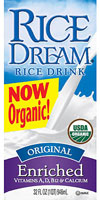
 I picked up a box of Rice Dream non-dairy beverage (rice milk) at the grocery store yesterday and after years of warnings from fellow celiacs not to buy Rice Dream because it contained barley, I was surprised to find that it is now labeled gluten-free.
I called Rice Dream, which is part of Hain Celestial, which owns so many brands that they have customer service reps who sit there all day and read statements from their computers to answer consumers’ questions. Anyway, to get to the point: According to the customer service rep, Rice Dream has not changed their recipe. They now test “each batch” for gluten and say that the barley enzyme content is so small that the product can be considered gluten-free.
Currently, there is no U.S. standard for labeling something gluten-free, although it is in the works. You can read about the U.S. Food and Drug Administration’s proposed gluten-free labeling rule. For information about current worldwide gluten-free standards, see celiac.com’s explanation.
I have now idea what standards Rice Dream is using, but now that it is labeled gluten-free, I guess I will buy it…? I am a little hesitant, but I like that it is easy to find in stores and that they have lunch box sizes to take on-the-go. Plus, there are lots of flavors, like vanilla, chocolate, carob (for those that can’t have chocolate), vanilla hazelnut and chocolate chai.
Note: The gluten-free label is only on the beverages. Some flavors of Rice Dream frozen desserts have gluten – check the label.



Becky S. says
Our doctor said that the gluten content in Rice Dream was so low that our son would have to drink a gallon a day for it to do anything to him. He said it’s okay, not to worry about it.
Heather says
Since there are other gluten-free, dairy-free beverage alternatives out there, I’m not willing to drink barley-enzyme-containing Rice Dream. If there’s just a little gluten in this and a little gluten in that all day long … it adds up. I guess you have to decide where and when you want to take the risk of knowingly exposing yourself to gluten your diet.
Ellen says
What do they define as “so small that the product can be considered gluten free”? Who is doing the defining?
This from a UK review study (http://www.coeliac.co.uk/healthcare_professionals/healthcare_newsletter/506.asp –scroll down to “Project update.”):
Key outcomes of the systematic review:
• There is not enough evidence available to support the current Codex standard of 200ppm so this level would appear not to be sufficiently protective for all people with coeliac disease.
• Results from the studies reviewed suggest that some patients exhibit symptoms at much lower doses of gluten than others.
• A daily consumption of 200mg or more of gluten clearly induced mucosal changes and/or symptoms.
• There is not enough evidence available to be able to derive a specific threshold dose that would be tolerated by all people with coeliac disease.
“Gluten free” is becoming a money-making marketing angle. I’m with Heather. There’s no point when other options exist.
Heather says
Thanks for the specific info. and link, Ellen. I’ve grown increasingly annoyed thinking that something that contains a barley ingredient can be labeled gluten-free. One of my relatives has an extreme dairy allergy, and how absurd would it be for him to buy something labeled “dairy-free” that actually had a dairy ingredient? It likely would cause an allergic reaction. When something says “gluten-free” the implication is that it contains no wheat, barley, or rye — and a person that is allergic, rather than gluten-intolerant (the two are somewhat different) might be led astray by the gluten-free label. It’s bad enough for the gluten-intolerant individual to be led astray. I agree that it seems like some companies are not using the labeling system in good faith, just so they can market their products.
alison says
A reader wrote a letter to Rice Dream and said that I could post it on the site. Here it is:
I used to use Rice Dream for my kids’ cereal – for the last 20 years, but had to quit using the product when I discovered my own gluten intolerance. Recently, your labels changed to reflect “gluten free.” I tried it again. Suddenly my old symptom (a rash all over my back) was back. And then I discovered on line, that no recipe had been changed.
Gluten intolerance is serious. A teensy tiny bit will make some of us truly suffer. Printing gluten free on a product that has even a smidge of barley can be toxic for someone like me.
Please rethink this. It seems to me you could turn out a fine product by changing ONE ingredient and truly protecting those special shoppers who NEED to purchase gluten-free (not gluten reduced) products.
Sarah Schatz - menu planner for people with allergies says
I see this is an old post but found it by searching information about if Rice Dream is gluten-free or not. I looked at my box and it does not say “gluten-free” on it and this is a year and a half after this was posted. Maybe they stopped claiming they were gluten-free because of complaints? But then I found their website and they claim that their milk is gluten-free on the website??
So, I have to confess, since going gluten-free last year because I discovered through my own process that I am highly gluten-intolerant, that I didn’t know this about Rice Dream. So was drinking it every once in a while. It turned out to not be very often because I switched to Almond milk last year simply because it is more nutritious, but I do know there were times I was drinking it. I was also having reactions and not knowing what was causing it, and it could very well have been the Rice Dream.
This all came about because I accidentally got some Rice Dream ice cream that had barley malt in it. I should have realized it after I reacted to it twice but finally looked at the ingredients more closely. But it was just in the carob chips so I thought, hey, I guess I can eat the ice cream part. I still reacted and that was the end of my Rice dream ice cream. Then I found a post that said that the actual milk has the barley in it.
So I still am not completely sure if I reacted to the milk or not, but I really don’t want to find out by testing it again because my reactions can be very intense and take a couple days to completely wear off.
My vote is to stay away from Rice dream and go with almond milk or another GF rice milk. Also, Coconut ice cream is the bomb.
Thanks for posting this,
sarah
Carol Ann SUddeath says
Too bad it has soy in it…
alison says
To my knowledge, Rice Dream does not have soy in it. Soy Dream, of course, does.
missy says
We have found rice milk to be wonderful for my child’s corn allergy- so long as it is not vitamin enriched. I did see at the store where one of the brands did have a soy derivative listed in the ingredients:(.
M. Chamberlain says
I have tried using Rice Dream drink previously and was having troubles with it, so I stopped using it. I recently purchased some (it said “gluten free” on the package) and today used it in a tuna casserole. After eating some of the casserole, I had a very bad reaction. Everything else I used in the dish had been used many times. I know it was the Rice Dream. They should not be allowed to put “gluten free” on anything that even has the smallest amounts of a gluten product in it or has been in the manufacturing of it. Some of us get very ill.
Mae says
Even though Hain CLAIMS their rice beverage product is gluten-free, it is NOT. Since I changed from So Delicious coconut milk to Hain’s Rice Dream rice milk I have had increasingly horrific pain in my upper right flank, low-grade fever, terrible fatigue, and horrible diarrhea for the last six months. My body was acting like I had been glutened. I have spent months trying to figure out what I was eating that had gluten in it. The answer was: nothing. Apparently, I was drinking it.
Two days ago, I did a Google search for “Rice Dream rice milk gluten†and found many celiac forums and Celiac Disease experts cautioning against this brand of rice milk. Many people have written online in celiac forums about how they react badly to Rice Dream rice milk. When I started using Rice Dream rice milk, I had checked out Hain’s website to make sure that Rice Dream was gluten free before purchasing it. They said it was.
They lie – and the FDA allows this lie.
Hain uses a barley enzyme in the beginning process of making the milk. Hain is lying when they say on their site: “Is Rice Dream Beverage a gluten free product? Yes. Although Rice Dream Beverage is processed using a barley enzyme, the barley enzyme is discarded after use. The final beverage might contain a minute residual amount (less than .002%) of barley protein.†They state that they use it and then “throw it out.†But apparently it is still in the rice milk no matter what they say because I have reacted strongly to it. In fact, once the barley enzyme is in the rice milk, how in the world can it be separated out?
Hain also says that any gluten that might be in their product is below the FDA threshold of 20 ppm. But the problem is that the commercial tests for gluten contamination have some difficulty detecting hordein (the type of gluten protein found in barley) when the hordein has been broken down into smaller pieces or protein fragments.
It is also possible that there is not enough residual gluten left in the product for testing to detect (at least not with current tests), but there is plenty of gluten in Rice Dream rice milk for our bodies to detect it and be damaged by it, especially in people who tend to be very sensitive to even trace amounts of gluten.
More and more people do not trust the Rice Dream beverage – and they do indeed react like I have reacted. In fact, I drank the Rice Dream rice milk long enough to do further damage to my duodenum. It could take months and months to get over this glutening episode.
One would think that Hain would be more concerned about the dangers of gluten (and celiac disease) and not sell products that are made with anything that ever contained gluten. I will never buy Hain’s rice milk again or any of their products for that matter because I cannot trust them. And I will join others in spreading information all over the internet about the gluten dangers in Rice Dream rice milk.
Please do consider what I have said and do not trust what Hain claims their rice milk to be (gluten-free) because it is not.
The FDA is as much to blame for my glutening as Hain is. The FDA is too lax in what they allow in gluten-free products. 20 ppm is way too high for many Celiacs like myself. Celiac Disease is serious. A teensy tiny bit will make some of us truly suffer. Printing gluten free on a product that has even a smidge of gluten can be toxic for someone like me.
I have been off the Rice Dream for 2 days. Already the pain is subsiding and I am feeling a bit better.
I am so angry at Hain, I could spit nails!
Mae says
Here is some more information about the gluten in Rice Dream:
The EU directorate states that this product should be labeled “contains gluten” and should also state it was produced in a factory handling gluten. Check out the statement I found on the Rice Dream EU website that says sensitive Celiacs should not use their beverage: “… the end product may contain minimal traces of barley protein from an enzyme used in the production process. This enzyme comes from barley, and although the amount of gluten is very small – fewer than 20 parts per million – we advise anyone with an extreme sensitivity to gluten to consult their doctor and make sure that Rice Dream is suitable for them.†http://www.ricedream.eu/faq#n626