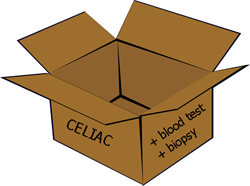
 I am 1 person in 100 that made it into the Box. The Celiac Box, that is. I have Celiac Disease. That gives me credibility. That makes my being on a gluten-free diet valid. The 99 of you who didn’t qualify to be in the Celiac Box? Your stories about feeling better on a gluten-free diet are questionable, doubtful even. If you’re not in the Celiac Box, you don’t need to be on a gluten-free diet — and why would you deprive yourself? You probably just have Irritable Bowel Syndrome or a parasite or something. You are not in the Celiac Box — now go eat a piece of pizza, take a purple pill, and quit complaining!
Celiac Disease affects approximately 1% of the population. There are genetic markers that can tell if someone is predisposed to developing it. There are studies that link celiac disease to many other health problems, such as osteoporosis, anemia, even neurological diseases such as schizophrenia. There are tests for celiac disease and if you test positive, then you’ve got a disease and the gluten-free diet isn’t just something you’re trying on a whim — you have been diagnosed and a gluten-free diet is your medically prescribed treatment.
And if you test negative for celiac disease? Well, then, you don’t have it. You become part of the 99% of people who don’t have it. You feel better on a gluten-free diet, you say? Go ahead, be on a gluten-free diet, but it’s not necessary, because you don’t have celiac disease. Unfortunately, these are often the last words that a patient hears from his doctor after testing negative for celiac disease.
Listen up, people: It is time to THINK OUTSIDE THE CELIAC BOX!
To be diagnosed with celiac disease, you must meet strict testing criteria which includes visible damage to the intestine (from samples taken during biopsy). If it’s not visible, or if the person checking simply misses it, there is no diagnosis. NO DIAGNOSIS. Because doctors don’t have a way to confirm that gluten is harming someone without visible damage to the intestines. The person doesn’t fit into the Box.
So if it’s not celiac disease, what is it? Here are some reasons a person could test negative for celiac disease, but still could benefit from a gluten-free diet:
- Blood tests can be falsely negative.
There are people who test negative but actually have the disease. This could be due to the fact that the person is not eating much gluten already because he knows that it makes him feel bad. Not eating enough gluten can produce a false negative on the blood test. If the person had been eating a lot of gluten, the test result may have been positive. - A person could be “pre-celiac” or have “latent celiac disease.”
There are some people who test negative on a blood test now, but positive later after more damage is done. According to Dr. Peter Green in his book Celiac Disease, A Hidden Epidemic, this situation may be seen in younger children and young adults who have negative blood tests but develop celiac disease later in life. - A person could have “non-celiac gluten sensitivity (NCGS)”, “non-celiac gluten intolerance”, “gluten sensitivity”, or “gluten intolerance.”
These terms all refer to the same idea, that a person could be reacting to gluten without having the specific type of damage attributed to celiac disease. The reactions could be the same and as strong as those seen in people with celiac disease, however. This is an area that currently is not in the mainstream medical thought. This is outside the Celiac Box.
I believe strongly that we need to start looking at gluten sensitivity as a spectrum, with celiac disease at the extreme. I realize the difficulty that doctors face when there are no reliable, accepted, mainstream tests for gluten sensitivity (yet), but it should also be recognized that the celiac tests are not reliable for those that don’t fit into the Celiac Box.
It should be acknowledged that non-celiac gluten sensitivity exists and that it has the same treatment as celiac disease: a 100% gluten-free diet. By not being informed of the existence of gluten sensitivity, people are being denied a treatment that works and are becoming dependent on drugs to mask their symptoms rather than treat the cause of their ill health.
In my family, I am the only one who was diagnosed with celiac disease, yet besides me, there are 8 people who are on a gluten-free diet. None were advised by their regular doctors to do the diet. 6 of them tested negative on the traditional celiac blood tests. Of those 6, 2 had a biopsy anyway and still tested negative for celiac. 2 people never took any celiac blood tests at all. ALL of them feel dramatically better on a gluten-free diet. ALL of them have had their health problems — gastrointestinal, neurological and behavioral — reversed on a gluten-free diet. NONE of them want to ever eat gluten again. Now, I ask you, where are my family members in the celiac statistics?
There are several doctors out there who are working to make it known that gluten is a bigger problem than anyone realizes, and that perhaps as much as 10-40% of the population is actually gluten sensitive. I hope that their research and messages will soon be widely recognized so that people can stop being sick. I highly recommend reading their books and websites:
- Dr. Kenneth Fine is a gastroenterologist board certified in internal medicine and gastroenterology. He runs Enterolab (www.enterolab.com) that tests for gluten sensitivity. The website also has a lot of great information on gluten sensitivity.
- Dr. Stephen Wangen is a state licensed and board certified physician specializing in digestive disorders and food allergies. He is the author of the book Healthier Without Wheat, A New Understanding of Wheat Allergies, Celiac Disease, and Non-Celiac Gluten Intolerance. He also has a blog, The Gluten Free Doctor.
- Dr. Rodney Ford is a Specialist Pediatrician, Gastroenterologist, Allergist and Nutrition Consultant in New Zealand. His website is www.drgluten.com. He has also written several books, one that I have read called “Full Of It! – the shocking truth about gluten”, and has articles on Celiac.com.
- Dr. Scot Lewey is a gastroenterology physician (specialist in digestive diseases) who is an expert in food related and leaky gut disorders including Celiac, colitis, Crohn’s disease, IBS, mastocytic enterocolitis and eosinophilic or allergic problems. He has written numerous articles about these topics which can be found on Scot Lewey’s Ezine Articles and Scot Lewey’s Celiac.com Articles. He also has his own site, www.thefooddoc.com.
Related reading:
Is the gluten-free diet torture?
Progress in treatment and screening for celiac disease
Blood tests are not the final say
Non-Celiac Gluten Sensitivity








Jennifer B says
This is a super post. Really interesting. Wow-well done! I am going to have to read it a few more times and check out these links…Thank you.
Kelly says
Amen! I’m now reading Dr. Wangen’s book right now! I like how you wrote this…very clear and logical.
alison says
Dr. Wangen’s book is so good!
WendyGK says
Amen!!! When the doc at the last celiac conference I attended said it was irresponsible for parents to make siblings w/o a diagnosis go GF even if it was easier for the family to go GF and the kids felt better, I walked out for a few deep breaths. If the kids are negative, but have symptoms like IBS… are reduced and they have family members with the “Gold Standard” diagnosis, it’s irresponsible to deprive the kids of gluten and the social aspects of eating gluten. They still don’t get it. Even the supposed “good guys.” I’m done ranting. Thanks for saying all this.
zia says
I HATE the Celiac box!! Thanks for saying so well what I’ve been thinking for months! I fall into that limbo outside the box because I’m so sensitive, I can’t tolerate a gluten challenge for formal testing. I had a negative blood test 10 years ago, but I’m sure I was probably pre-Celiac. I have 2 family members formally diagnosed. So, I can either call it what it probably is based on genetics and family history, or put up with the crap of an ambiguous label for the rest of my life. Most people know what Celiac is, but almost no one knows what gluten intolerance is, and I’m sick of explaining, because it always ends with “Oh! Like Celiac?” Yes. Just like Celiac. [smacks hand on forehead] It may be sacrilege, but I’m calling it Celiac without getting the Gastroenterologist’s blessing (or bill.) When they come up with a reliable way to test for Celiac without forcing the patient to endure weeks of needless suffering, I’ll do it. Until then, I’m stowing away in the box. >:)
karla says
Loved this! Absolutely right and loved how it was written so clearly. I will send this to my friend with Ulcerative Colitis (who’s family has a history of gluten intolerance) and maybe they will see it in black and white that they would benefit on a GF diet and I think they will understand it better that I am abel to communicate it to them. I love all the docs in your list of reccommended websites and books to read. They all have great information on their websites. I used Dr. Fine’e Enterolab for gluten testing on me and my child, with lots of confidence. I was very pleased that I could test for the genetic marker for Celiac Disease while being on a gluten free diet. I was not going to have any testing done that required me eating gluten agian. I subscribe to Dr. Lewey’s websites and recieve loads of great information from him usually once a week. Thanks for a well written article.
Anna Wrafter says
Excellent article, and the comments are heartening. This is a terrible condition to live with, ever so difficult. I can’t believe that I had lived so long not knowing what was wrong with me, and only being diagnosed after being seriously hospitalised.
Melanie says
This was an excellent post! I am one of those outside the box. I had a positive blood test but when I had the biopsy, my doctor was informed that I had a negative gene test when in fact I had never had a gene test at all. My biopsy came out negative. It makes me wonder if he even looked very hard for celiac when he had been misinformed that I didn’t have the gene. He wasn’t corrected with this misinformation until after he had done that biopsy. By the time I found out that is what his thinking was the day of biopsy, I had been gluten free for about a month and was feeling so much better there was no way I was going back. So, I will never truly know. I consider myself to have celiac disease because of the positive blood test, but it’s really not official because I have no positive biopsy.
Andrea says
Thanks for this. I have a cousin who has the diagnosis and a lot of family members on my moms side have digestive issues, even my mom does, but she refuses to try it and just lives with it. I was diagnosed with a wheat allergy and went gluten free from there, I have never felt better. The one time they did a blood test was after I had been off gluten for half a year so of course it came out negative. I don’t even want to try testing because I know how I feel if I eat wheat, especially after having been off it for so long. Personally I’d rather be outside the box then let it get worse.
Anne says
Excellent post. I wish more doctors would “get it”. I will send a link to your post to others. Thanks.
Anne says
Karla, you say you subscribe to Dr. Lewey’s website and are getting updates. I had subscribed, but I have not heard from him in about a year. Do you have a current website? I would love to subscribe to his updates.
Thanks.
Dr. Stephen Wangen says
Hi Alison,
Thanks for writing about this important topic. As you already know and can see by the comments to this post, most people who are gluten intolerant do not have celiac disease. Unfortunately this is going to take a long time for most doctors to recognize. Just consider how long it took for them to recognize celiac disease!
Fortunately, there are many tests that help to diagnose this, and of course people can simply stop eating gluten and they may find out that they feel a lot better. My book, “Healthier Without Wheat: A New Understanding of Wheat Allergies, Celiac Disease, and Non-Celiac Gluten Intolerance” discusses all of these issues and all of the problems that the people who’ve posted have brought up.
The average person can be much smarter than most doctors when it comes to gluten intolerance, at least if they trust their instincts and listen to what their body is telling them. Keep up the great work. You’ll help many people!
Thanks
Dr. Stephen Wangen
http://www.HealthierWithoutWheat.com
Bonnie, The Sensitive Diner says
Fabulous article, very well done! All of us non-diagnosed celiacs have experienced much of what you and your family have experienced. It’s so very frustrating talking to the typical western medical community. And, because people still view doctors as gods, it takes them a long time to believe that those doctors don’t have all the answers. Thank you for identifying some of the good ones!
Bonnie
Gayle Kennedy says
Alison, I found or morning communication so
interesting, I went back to read the rest of
your items. The one on my screen now is
“Think outside the Celiac Box”.
For many years I wrote to the LIST saying that
I thought that celiac disease was part of a
continuum – with full blown celiac disease
(DH and all) at one end, and complete good
health at the other. Irritable bowel syndrome
would be along that line, and probably the
even beyond full blown celiac disease would be
Crohn’s disease. Of course no one would go
along with me, but it still makes sense,
especially because I was only exhibiting full
celiac symptoms after age 40, yet the bad teeth,
the occasional diarrhea or nausea, being skinny
in spite of eating voraciously – all seem to
fit along the line. Your term is spectrum, but
the end result is the same.
Gayle
Pete Dixon says
I’ll add another piece to this picture. I’m on disability and can’t get a Celiac diagnosis because eating gluten makes me far too sick to do the preparation for the biopsy. I have the family history, get a fever and herpetiform dermatitis and immediately sick with nausea and diarrhea, but my GI specialist and my GP insist I’m not qualified for the benefits until I have a positive test.
How would they like to have non-stop diarrhea and fever for a month I ask. They tell me to be reasonable. Right..
Vonnie says
At first this post mad me angry. How dare someone say I don’t fit in the box just because I don’t have a formal diagnosis. I am glad I checked my emotions and read on. It was a well thought, informative, timely piece. I recently went GF for health reason unrelated to celiac disease but still fell immensely improved in just one week, although I have much to learn and much to recover from. Last night I gave to temptation for a fresh baked dinner roll and herbed olive oil but left 2/3 of it. UNHEARD OF! I used to devour breads. I am what I eat and I choose to nourish my body and quit fight it. Thank you for your post.
Marion says
Wow! I’m new to this gluten free stuff and had no idea there are so many symptoms. I’ve spent the morning on the web and really find you’re articles helpful. (especially the POO). Like the others, I will not go back on gluten just to satisfy my docs and get tested. I have some questions, though: 1) how long before the gluten atxia (sp?) goes away? and 2) what will I eat when I go to Italy??
alison says
Marion,
Not sure how long for the ataxia to go away… keep me posted on that one!
You should be fine in Italy — risotto and polenta are gluten-free. Plus, they have gluten-free pasta there, as they are actually more aware of celiac disease than we are. Gluten-Free Girl wrote about being gluten-free in Italy:
http://glutenfreegirl.blogspot.com/2007/10/eating-gluten-free-in-italy.html
Brooklyn says
Interesting and thoughtful post. I think the best way to diagnose any sort of food allergy is to follow an elimination diet and carefully integrate suspected foods back into your diet. My experience shows Western Medicine diagnostic tests sometimes fail. I had MAJOR problems before self-diagnosing myself as gluten-intolerant. On a gluten free (and corn free) diet, I am fine. My mom also did the Dr. Circuit to no avail. When she finally quit eating gluten, she got better – much, much better!
Dawn Bentley says
Thank you for the information! My blood test results came back negative today. I was so disappointed. I thought I finally had an answer after 3 years, 6 doctors, and so many bogus diagnoses it’s disheartening! Can you imagine being disappointed you don’t have a disease!? Just biopsied the DH looking rash on my knees and elbows today. Thanks to this article, I really no longer care what the results are. I’ve been GF for 4 days and I am already experiencing some relief. I pray this nightmare is over, for me and for you.
Tina says
This is EXACTLY what my family experienced. In fact, not one of us tested positive for celiac disease; however, with a gluten-free/dairy-free diet my son’s symptom’s of crohn’s disease went away. My brain fog, and my mother’s bone pain diminished with the gluten free diet. I’ve seen chronic depression lift, ADD symptoms go away, back pain go away…and the list goes on.
Excellent article. Thank you for spreading awareness. You will help many people!!!
Alison says
Tina,
I always wonder about Crohn’s disease and have tried to do research on the gluten-free diet and Crohn’s with not much luck. Thanks for commenting.
Susie Cue says
You need to take this site down. Your are not helping anyone by being so negative. Just Because someone does not qualify for Celiac (I wouldn’t want to be in your box), does not mean we don’t have all the symptoms and experience the same issues you do.
Alison says
Hi Susie,
I don’t you think you read the whole article. I was speaking from the perspective of the common doctor back when I wrote that article in 2009 (and unfortunately, many people still think this way). I was one of the few at that time who argued that we should NOT just give credibility to celiac disease, that we should look at gluten sensitivity as a spectrum. If you read farther down, you will see that I said:
“I believe strongly that we need to start looking at gluten sensitivity as a spectrum, with celiac disease at the extreme. I realize the difficulty that doctors face when there are no reliable, accepted, mainstream tests for gluten sensitivity (yet), but it should also be recognized that the celiac tests are not reliable for those that don’t fit into the Celiac Box.
It should be acknowledged that non-celiac gluten sensitivity exists and that it has the same treatment as celiac disease: a 100% gluten-free diet. By not being informed of the existence of gluten sensitivity, people are being denied a treatment that works and are becoming dependent on drugs to mask their symptoms rather than treat the cause of their ill health.”
I hope you will continue to use my site as a resource!
-Alison